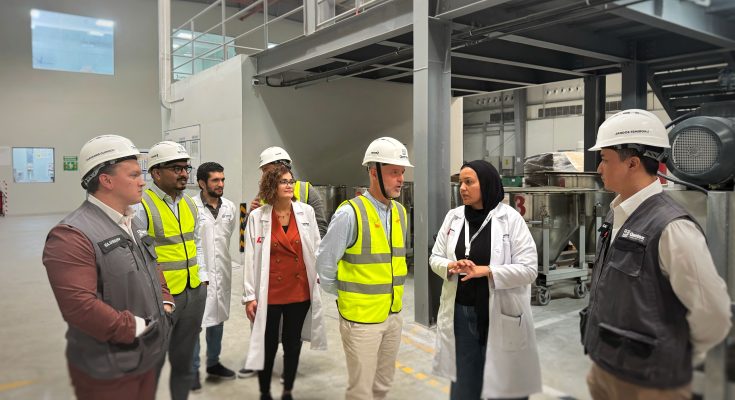
Transforming the Coatings Industry
From Increasing Volumes to Increasing Complexity
Looking back over the last 10–15 years of the coatings industry’s development, it becomes clear: for a long time, the market grew primarily quantitatively. Construction volumes increased, production capacities expanded, and consumption in mechanical engineering, infrastructure, and architecture grew. In this logic, the key issues were capacity, price, and product availability.
However, by today, this model has ceased to work in its purest form. The industry has entered a phase where growth no longer means simplification, but, on the contrary, is accompanied by increasing complexity of processes, requirements, and responsibilities. It is no longer enough for a coatings manufacturer to simply “know how to produce.” They are expected to be able to manage a complex system: supply chain, energy, increased customer needs, regulatory changes, big data, and the product lifecycle.
Powder coatings are no longer a niche technology or an “eco-friendly alternative.” By 2025, they will be firmly established as the foundational platform of the modern coatings industry — provided they are backed by a mature operational and engineering logic.
Why 2025: A Confluence of Several Factors
The year 2025 wasn’t revolutionary in itself. It was the confluence of processes that had been building for years, but now began to act in unison.
First, attitudes toward global supply chains have changed. Companies that have survived the pandemic, logistical disruptions, and geopolitical restrictions are increasingly asking themselves: How resilient is my business in the event of an external shock? The answer is less and less about global optimization and more and more about regional reliability. This means localization, shorter supply chains, and increased demands for consistent quality within a region.
Secondly, energy is no longer a “background concern.” In Europe, prices are rising, in the US, there are massive investments in infrastructure, and in Asia, there is pressure on production costs. For any production, including coatings, the energy profile has become as important a parameter as the formulation or line throughput. And here, powder technologies, with the right process tuning, gain a structural advantage.
Third, regulatory connectivity across markets has increased. Even if the requirements formally differ, their underlying logic is similar: transparency, measurability, and accountability. This means that a company operating in multiple regions must be able to adapt without constantly restructuring the entire system.
Fourth, the green agenda is becoming a global trend and entering a practical phase. Increased demand for eco-friendly solutions is giving impetus to the powder coatings industry.
North America: A Market of Opportunities
The US market in 2025 remains one of the most attractive and, at the same time, most demanding. There is no “average” customer here. There are either high demands and standards or fierce competition based on price and efficiency. It’s important to understand that the US is not a single market, but a collection of state markets, each with its own industrial policies, incentives, and priorities.
For powder coatings, this means steady growth in architecture, aluminum extrusion, industrial equipment, transportation, and energy. But this growth is accompanied by demands for reproducibility, traceability, and stability that go far beyond conventional specifications.
If you’re working or planning to work in the US, the question isn’t, “Is there demand?” Clearly, there is. The question is, “How capable is your system of withstanding constant monitoring, auditing, and scaling without losing quality?”
Europe: A Market of Maturity and Durability
The European market in 2025 will be less volume-oriented and more focused on sustainability and product lifecycles. Here, coatings are viewed not as consumables, but as part of a systemic solution for buildings, vehicles, and industrial facilities.
For powder coatings, this means increasing demands on durability, environmental impact, color stability, resistance to aggressive environments, and minimal maintenance. European customers increasingly consider not the price per kilogram, but the cost of ownership over a 15–25-year horizon.
If you work in Europe, you’ve likely already encountered this shift: questions about re-application, the choice of sustainable raw materials and components, and recycling are raised as often as questions about appearance.
GCC and the Middle East: Extreme Climate as a Technology Driver
The UAE and GCC markets in 2025 are increasingly perceived not just as fast-growing, but also as technologically transformative. The region’s climate — high temperatures, increased UV exposure, sand, and salty air — makes any compromises in coatings obvious within the first few years of use.
Here, powder coatings undergo accelerated “reality testing.” Superdurable and hyperdurable systems, fade resistance, and retention of mechanical properties are not marketing terms, but basic approval conditions for projects.
For the industry as a whole, the GCC is becoming a testing ground for solutions that are then applied in other regions with increased climatic stress.
Asia and Emerging Markets: Balancing Price and Quality
Growth in Asia remains robust, but even here, a shift toward stability and control is noticeable in 2025. Clients are increasingly unwilling to tolerate variations in quality and increasingly value consistency and predictability.
For powder coatings, this means competition not only on price but also on process efficiency: material consumption, line speed, and defect rate. And here again, those who can manage the system, not just the product, win.
Energy, Hardening and Flexibility
Low-temperature, energy-efficient curing systems are no longer experimental in 2025. They are becoming a response to real-world constraints: energy costs, substrate diversity, and the need for rapid changeovers.
If you manage a production line, you already understand that line flexibility is becoming just as important as its maximum productivity. Powder technologies offer ample room for maneuver here — with proper engineering setup.
From Versatility to Precision
Another important shift is the move away from one-size-fits-all products. The market increasingly demands customized solutions optimized for specific conditions: climate, substrate type and preparation methods, service life, and mechanical loads.
This complicates the portfolio, but simultaneously increases the value of the manufacturer’s expertise. Today, the winners are not those with the widest product range, but those who are able to solve the client’s problems.
Durability as an Economic Category
Coating durability is increasingly viewed not as a technical bonus, but as an economic factor. The longer a coating lasts without intervention, the lower the overall cost for the customer — and the greater their loyalty.
This shift is particularly noticeable in infrastructure, architecture, and industry, where downtime or rework costs many times more than the material itself.
What Does This Mean for the Industry as a Whole?
The main change of 2025 isn’t technology per se, but a shift in thinking. The coatings industry can no longer develop linearly, adding capacity and products without considering the context.
Today, it’s a multidimensional system where product, market, energy, data, and management are interconnected. Powder coatings have found themselves at the center of this system because they fit better than other technologies into the new architecture of industrial development.
But this in itself does not guarantee success. It will belong to those who can transform the technology into a system.
The year 2025 marks a new reality: the coatings industry has entered a period of maturity. And in this era, the winners are not the biggest and brightest, but the most systematic and adaptable.
Latest news
Our latest stories in focus.